Geocells, also known as cellular confinement systems, are innovative three-dimensional honeycomb structures that revolutionize soil stabilization, erosion control, and load distribution in civil engineering and environmental projects. Fabricated from durable polymers such as high-density polyethylene (HDPE) or polypropylene (PP), these expandable panels confine infill materials like soil, gravel, or concrete, creating composite mattresses that enhance structural integrity and reduce settlement. In 2025, the global geocells market is valued at approximately $795 million and is projected to grow at a compound annual growth rate (CAGR) of 9.7% to reach $1.55 billion by 2032, propelled by infrastructure development, sustainable land management, and resilient roadway solutions worldwide. This comprehensive guide from Shandong Geosino New Material Co., Ltd. (Geosincere Geosynthetics), a leading geosynthetics manufacturer with over 15 years of expertise in producing ASTM-compliant products, explores geocell pricing in detail. Prices typically range from $0.50 to $5.00 per square meter ($0.046–$0.46 per square foot), excluding installation which can add 20-50% to the total budget, depending on factors like material type, cell height, and project scale. For engineers, contractors, and project managers involved in roadway bases, slope reinforcements, or coastal protections, understanding these cost dynamics facilitates precise budgeting and superior performance outcomes.
1. What Are Geocells?
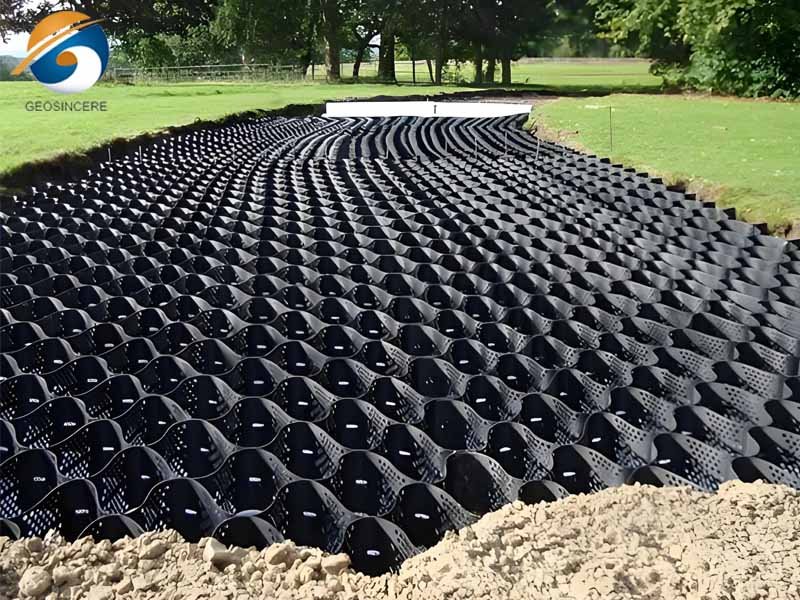
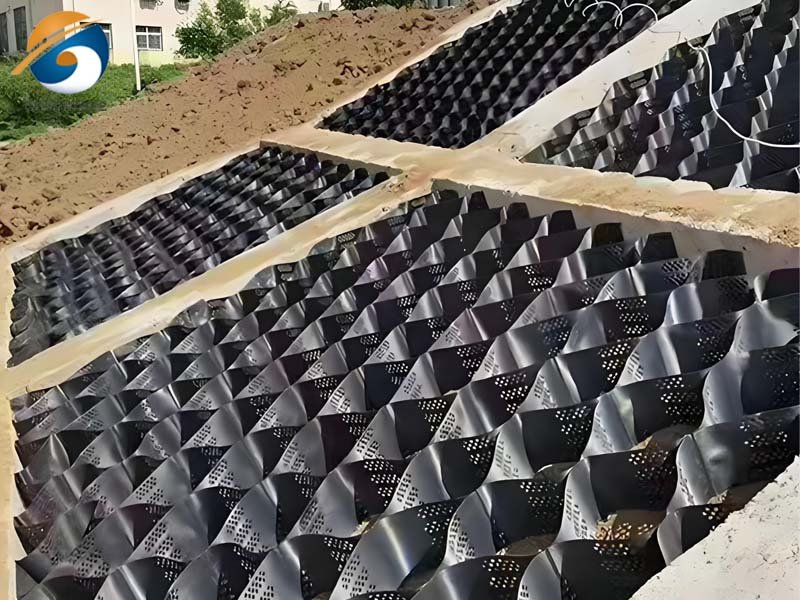
Geocells are geosynthetic materials consisting of interconnected cells formed from welded polymeric strips, designed to stabilize weak soils and distribute loads effectively. Unlike traditional geogrids or geotextiles, geocells provide volumetric confinement, preventing lateral movement of infill and increasing shear strength by up to 300% in soft subgrades. Produced through ultrasonic or hot-air welding processes using high-quality resins, they comply with standards such as ASTM D5885 for perforated HDPE geocells and GRI-GC9 for general specifications, ensuring robustness in diverse environments. At Geosincere Geosynthetics, our geocells are manufactured using virgin HDPE or PP in advanced extrusion lines in Shandong Province, China, delivering panels with expansion ratios up to 8:1 and service lives of 50-100 years in buried conditions—potentially lowering long-term project expenses by 25-40% through minimized maintenance and material overuse.
Key Properties and Specifications
The performance of geocells is governed by engineered parameters optimized for specific geotechnical challenges. Drawing from 2025 industry standards from the Geosynthetic Institute and ASTM protocols, essential specifications include:
- Cell Height: Ranges from 50 mm for light-duty erosion control to 300 mm for heavy-load retaining walls, with taller cells enhancing confinement volume by 20-50% but increasing costs proportionally. A 150 mm height is standard for roadway sub-bases.
- Weld Distance/Strip Width: 330-1000 mm, determining cell size (typically 250 x 250 mm to 445 x 445 mm); wider welds boost tensile strength to 20-40 kN/m per ASTM D4595.
- Material Density: HDPE at 0.94-0.96 g/cm³ (ASTM D1505), offering superior creep resistance; PP variants at 0.90-0.91 g/cm³ for flexibility.
- Tensile Strength: Minimum 20 kN/m in machine direction (MD) and cross-machine direction (CMD) per ASTM D4595, supporting dynamic loads up to 500 kPa in vehicular applications.
- Elongation at Break: 10-20% for HDPE (ASTM D6693), ensuring ductility without excessive deformation under stress.
- Puncture Resistance: ≥400 N (ASTM D4833), 30% higher than non-perforated types, ideal for aggregate infills.
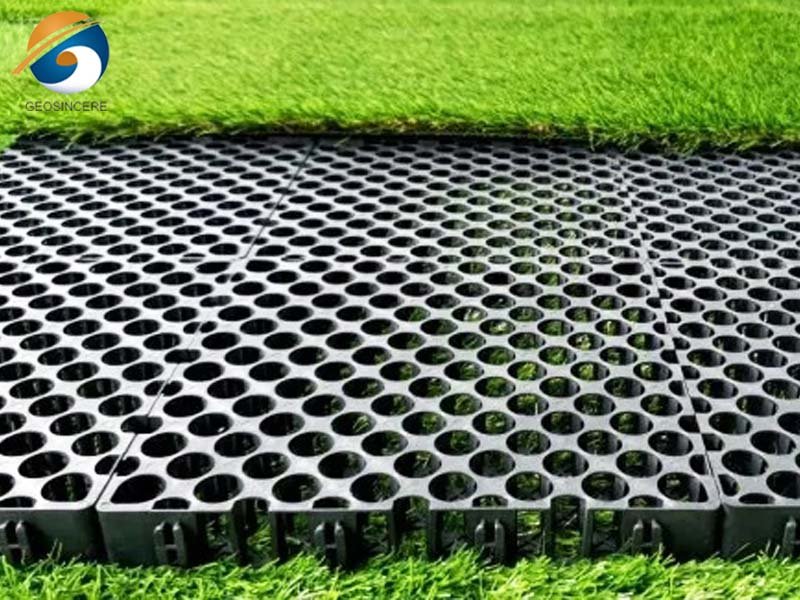
- Perforation Density: 20-40% open area for drainage (ASTM D4751 equivalent), with hole sizes 10-20 mm to facilitate 100-200 L/m²/s flow rates.
- UV Resistance: ≥500 hours exposure (ASTM D4355), retaining 80% properties post-1,600 kJ/m²; carbon black additives (2-3%) enhance longevity.
- Seam Peel Strength: ≥1.5 kN/m (ASTM D4885), critical for panel interconnections during deployment.
- Expansion Ratio: 6:1 to 8:1, allowing compact shipping (e.g., 4 m x 6 m collapsed panels expand to 30 m x 50 m).
These specifications not only ensure compliance with AASHTO and Eurocode requirements but also influence pricing, with perforated or high-tenacity variants adding 10-25% premiums for enhanced functionality.
Common Applications
Geocells are integral to over 60% of soil stabilization initiatives globally in 2025, according to market analyses, offering versatile solutions across infrastructure and environmental sectors. Key applications include:
- Soil Stabilization and Load Support: Beneath roads or railways to mitigate rutting; 100-200 mm cells with aggregate infill reduce settlement by 50% in soft clays.
- Slope and Retaining Wall Reinforcement: Gravity walls or vegetated slopes; perforated HDPE types promote root growth, stabilizing inclines up to 1:1 ratio and cutting erosion by 70%.
- Erosion Control: Channel linings or coastal dunes; biodegradable infills in 50-100 mm cells retain 90% sediment in high-flow areas.
- Foundation Beds: Under storage tanks or solar farms; 200-300 mm heights distribute loads over weak soils, preventing differential settlement by 40%.
- Channel and Hydraulic Structures: Lining culverts or ditches; textured surfaces enhance hydraulic stability, reducing scour by 60%.
- Environmental Protection: Landfill caps or mining haul roads; composite systems with geotextiles extend service life by 30%, complying with EPA guidelines.
- Temporary Access Roads: Construction mats; lightweight PP variants deploy 50% faster, supporting 20-ton vehicles over wetlands.
By optimizing infill usage—often reducing it by 20-30%—geocells deliver cost-effective, sustainable alternatives to conventional methods like deep excavation.
2. How Much Is The Geocell Price?
In 2025, geocell prices range from $0.50 to $5.00 per square meter, with averages of $1.50–$3.00 for standard HDPE panels in bulk quantities, based on supplier data from Alibaba and industry reports. This breadth reflects resin price volatility—HDPE up 5-8% due to petrochemical trends—and customization options, with installation contributing $0.50–$1.50/m² (20-40% of total). For instance, a basic 100 mm non-perforated HDPE geocell for erosion control may cost $0.80/m², while a 250 mm perforated polyester variant for heavy retaining walls reaches $4.50/m². Geosincere Geosynthetics provides high-quality geocells starting at $0.60/m² for large orders, including free seam strength testing to achieve 95% weld integrity.
The following dissection, informed by Geosynthetic Institute guidelines and 2025 market surveys, elucidates cost influencers, enabling 15-25% procurement optimizations.
2.1 Geocell Price – Material Type
Material composition drives 40-50% of costs, as polymer selection balances durability, flexibility, and environmental resistance. HDPE dominates for its longevity in harsh conditions.
2.1.1 High-Density Polyethylene (HDPE)
- Price: $0.50–$3.50/m², the versatile workhorse.
- Properties: Density 0.94 g/cm³, tensile 20-35 kN/m (ASTM D4595), ESCR >5,000 hours, perforation options for 150 L/m²/s drainage.
- Applications: Road bases and slopes; 70% market share for load support.
- Advantages: 50-100 year lifespan, 25% better creep resistance than PP, recyclable.
- Geosincere Example: HDPE geocells (100-300 mm height) at $0.70–$2.50/m², GRI-GC9 certified, used in 500 km of Asian highways.
2.1.2 Polypropylene (PP)
- Price: $0.40–$2.50/m², economical for flexible needs.
- Properties: Density 0.90 g/cm³, elongation 20-40%, UV stability >500 hours, suitable for seismic zones.
- Applications: Erosion control and temporary roads; excels in vegetated systems.
- Advantages: 20% lighter, 15% lower thermal expansion, cost-effective for non-critical uses.
- Geosincere Example: PP variants (50-200 mm) priced $0.60–$1.80/m², deployed in 300+ coastal protection projects.
2.1.3 Polyester (PET)
- Price: $1.50–$5.00/m², premium for high-tensile demands.
- Properties: Tensile 100-300 kN/m, hydrolysis resistant, ideal for wet environments.
- Applications: Retaining walls and geocomposites; supports 1,000 kPa loads.
- Advantages: 30% superior shear strength, 75-year durability in submerged apps.
- Geosincere Example: PET geocells (150-250 mm) at $1.80–$4.00/m², compliant with Eurocode 7, for flood barriers.
2.1.4 Novel or Biodegradable Variants
- Price: $0.80–$3.00/m², emerging for eco-projects.
- Properties: Starch-based blends, decompose in 2-5 years, tensile 10-20 kN/m.
- Applications: Temporary erosion mats; promotes vegetation.
- Advantages: 40% lower carbon footprint, aligns with green standards.
- Geosincere Example: Hybrid biodegradable at $1.00–$2.20/m², supporting reforestation initiatives.
HDPE holds 60-70% market dominance for its optimal price-performance ratio.
2.2 Geocell Price – Cell Height and Configuration
Height and perforation dictate 20-30% of pricing via material volume and manufacturing precision.
- Low Height (50-100 mm): $0.50–$1.50/m²; for light erosion or paths, infill savings 15%.
- Medium (100-200 mm): $1.00–$2.50/m²; standard for roads, confinement volume 200-400 L/m².
- High (200-300 mm): $2.00–$5.00/m²; heavy-duty walls, load capacity +50%.
- Perforated vs. Non-Perforated: +10-20% for drainage; Geosincere perforated HDPE (150 mm) at $1.20–$2.80/m², reducing hydrostatic issues by 60%.
Medium heights offer 20% lifecycle value for most infrastructure.
2.3 Geocell Price – Project Size and Scale
Bulk purchasing yields 15-35% discounts for areas over 10,000 m².
- Small (<5,000 m²): $2.00–$5.00/m², including minimum order fees.
- Medium (5,000-50,000 m²): $1.20–$3.00/m², 10-20% off.
- Large (>50,000 m²): $0.50–$2.00/m²; Geosincere tiers up to 30% rebates.
A 100,000 m² roadway project averages $200,000 at $2.00/m², versus $350,000 fragmented.
2.4 Geocell Price – Installation Method and Labor
Installation represents 25-45% of outlays, influenced by site and technique.
- Manual Expansion and Infilling: $0.50–$1.00/m²; staples or pins for flats, labor $15-30/hour.
- Mechanical Anchoring: $0.80–$1.50/m²; for slopes, geotextile underlay +$0.20/m².
- Infill Material: Aggregate $0.80–$13.00/m² depending on type; reduces volume by 20-30%.
- Site Prep Add-Ons: Grading +10-15%, remote access +20%.
Geosincere’s guides cut errors, saving 15-25% on labor.
2.5 Geocell Price – Raw Material Quality
Virgin polymers premium 20-40% over recycled, yielding 2-3x durability.
- Virgin Resin: $0.80–$3.50/m²; <1% defects, 50-100 year life.
- Recycled Blends: $0.40–$2.00/m²; for temporary, 10-20 year span.
- Additives (UV/Antioxidants): +5-15%, OIT >100 min (ASTM D3895).
Our virgin HDPE avoids $3,000–$10,000 rework penalties.
2.6 Geocell Price – Transportation and Logistics
Freight adds $0.10–$0.40/m², optimized by collapsed rolls (4-6 m wide, 50-100 m long).
- Domestic (China): $0.05–$0.15/m².
- International (US/EU): $0.20–$0.50/m², FOB Qingdao; 8:1 ratio saves 60% volume.
- Custom Panels: +5-10%, fewer seams on-site.
Geosincere’s location trims 15-25% vs. imports.
2.7 Geocell Price – Maintenance and Lifetime Costs
Routine checks cost $300–$1,000/year versus $5,000+ repairs; high-quality yields 40-60% ROI over 50 years. Perforated designs minimize clogging, extending efficacy.
3. How to Choose the Right Geocell
Selecting appropriate geocells involves aligning parameters with site demands to prevent 20-35% cost escalations from suboptimal choices. This step-by-step framework ensures efficacy.
3.1 Assess Project Requirements
Analyze soil CBR, loads, and hydrology. Road sub-base? 150 mm HDPE ($1.00–$2.50/m²) with 20 kN/m tensile. Slopes? Perforated PP 100 mm ($0.80–$1.80/m²) for drainage.
3.2 Prioritize Quality and Certifications
Opt for virgin, ASTM D5885-compliant from Geosincere; uncertified risks 15-20% failures.
3.3 Evaluate Installation Needs
Consider terrain: Slopes need anchors (+15%); our pre-perforated panels speed deployment 25%.
3.4 Consider Long-Term Costs
Taller cells (200+ mm) save 25-35% over 20 years via reduced infill/repairs; use ROI calculators.
3.5 Compare Suppliers and Request Quotes
Source 3-5 vendors; Geosincere offers 24-hour quotes, samples, 20% volume discounts.
4. Industry Trends Affecting Geocell Prices in 2025
The geocells sector, valued at $795 million in 2025 with 9.7% CAGR, is shaped by evolving dynamics.
- Resin Fluctuations: HDPE up 6-10% from oil prices, bases $0.60–$3.00/m² via stabilization.
- Sustainability Drive: Recycled/bio variants grow 25%, $0.40–$2.50/m², per EU directives.
- Smart Enhancements: Sensor-integrated +10-20% ($0.80–$4.00/m²), 30% monitoring savings.
- Infrastructure Expansion: $1.5 trillion global investments scale costs down 10-15%.
- Regional Variations: Asia ($0.50–$2.50/m²) 20-30% below Americas ($0.80–$4.00/m²).
Geosincere leads in perforated innovations.


5. Conclusion
Geocell prices in 2025, from $0.50 to $5.00 per square meter, vary by material (HDPE $0.50–$3.50/m²), height (50-300 mm), and scale, with installation/logistics adding 20-50%. Choosing certified virgin HDPE from Geosincere Geosynthetics guarantees 50-100 year performance, reducing ownership costs by 25-40% in a 9.7% CAGR market. For tailored quotes on HDPE, PP, or custom perforated geocells—for roads, slopes, or erosion control—contact Shandong Geosino New Material Co., Ltd. Our experts provide free consultations and samples.