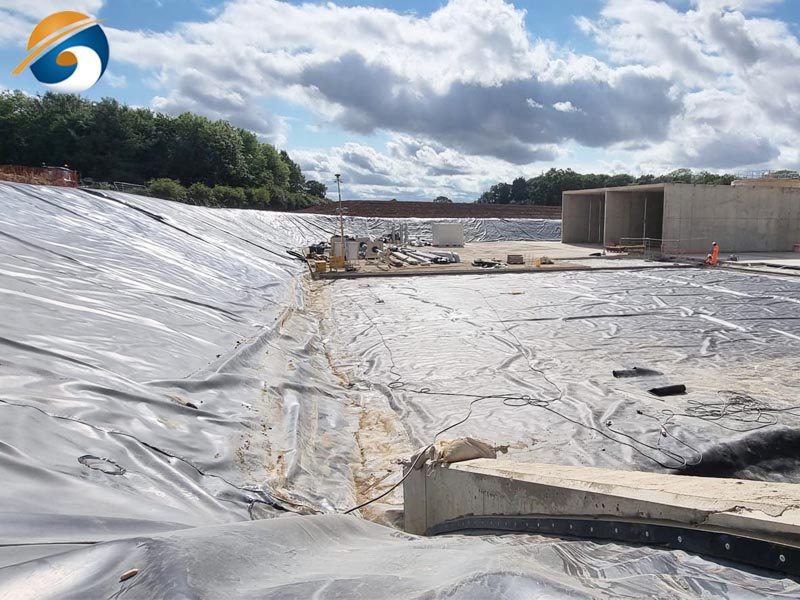
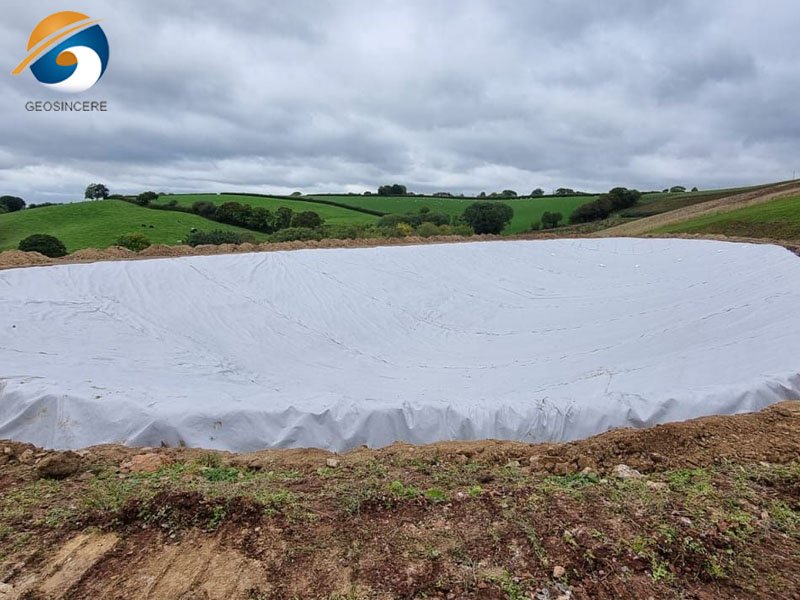
In the dynamic field of geotechnical and civil engineering, geotextile sheets have become indispensable for soil stabilization, drainage, and erosion control. As infrastructure projects worldwide escalate in scope—from expansive highway expansions to sustainable urban developments—procuring cost-effective geotextiles is paramount for engineers, contractors, and project planners. The geotextile sheet price in 2025 typically ranges from $0.15 to $0.50 per square foot ($1.61 to $5.38 per square meter), influenced by material type, weight specifications, and application demands. This in-depth guide unpacks the nuances of geotextile pricing, delivering data-backed analysis, technical specifications, and actionable strategies to empower informed purchasing decisions. Whether you’re outfitting a roadway base or a coastal erosion barrier, this resource equips you with the insights to balance performance and budget effectively.
The global geotextiles market, valued at $10.89 billion in 2025, is forecasted to surge to $28.90 billion by 2035, reflecting a robust compound annual growth rate (CAGR) of 10.24%, fueled by rising investments in infrastructure and environmental protection. Amid this expansion, understanding geotextile costs—projected to stabilize with a 5-7% annual increase due to raw material fluctuations—enables proactive budgeting. We’ll examine geotextile fundamentals, dissect pricing variables, outline selection criteria, and highlight emerging trends. Ultimately, you’ll gain a strategic edge in sourcing premium geotextiles from trusted providers like Shandong Geosino New Material Co., Ltd. (Geosincere Geosynthetics).
1. What Are Geotextile Sheets?
Geotextile sheets, also known as geofabrics, are permeable synthetic fabrics engineered to interact with soil or rock aggregates in geotechnical applications. Composed primarily of polypropylene (PP), polyester (PET), or polyethylene (PE), these sheets perform five core functions: separation, filtration, drainage, reinforcement, and protection. Their porous structure facilitates water flow while preventing soil migration, achieving permeability rates of 10-500 L/m²/s depending on weave density. Unlike impermeable geomembranes, geotextiles enhance soil mechanics without compromising hydraulic equilibrium, making them versatile for long-term site stability.
1.1 Key Components and Specifications of Geotextile Sheets
The efficacy and geotextile sheet price hinge on precise material and structural parameters. Core components include:
- Synthetic Fibers: Predominantly PP for UV resistance and chemical inertness (pH 2-13 tolerance), or PET for higher tensile strength in load-bearing scenarios. Fiber diameter ranges from 15-50 microns, with staple lengths of 50-100 mm for non-wovens.
- Fabric Structure: Woven (interlocked yarns for high strength) or non-woven (needled or thermally bonded for filtration). Roll dimensions typically measure 3-6 m wide by 50-200 m long, yielding 150-1,200 m² per roll.
- Performance Metrics:
- Mass per Unit Area (GSM): 80-1,000 g/m²; lightweight (80-200 GSM) for filtration, heavyweight (400+ GSM) for reinforcement.
- Thickness: 0.5-4.7 mm (ASTM D5199), with non-wovens averaging 1.2-2.5 mm for optimal compressibility under 200 kPa overburden.
- Tensile Strength: 10-350 kN/m (ASTM D4595); e.g., 350 N grab strength for drainage fabrics.
- Puncture Resistance: 200-1,500 N (ASTM D4833), critical for protective layers over geomembranes.
- Permeability: >100 L/m²/s (ASTM D4491) to ensure efficient drainage without clogging.
Compliance with standards like ASTM D4751 (sampling) and ISO 9863 (mass) ensures durability exceeding 50-100 years in buried applications. For instance, a standard 200 GSM non-woven PP geotextile roll weighs 150-200 kg, facilitating easy handling on-site.
1.2 Common Types of Geotextile Sheets
Geotextiles are classified by manufacturing process, each tailored to specific functions and influencing the geotextile sheet price:
- Woven Geotextiles: Interlaced slit-film or monofilament yarns create a grid-like matrix with high tensile modulus (>500 kN/m). Ideal for soil reinforcement in roads and retaining walls. Specifications: Aperture size 0.1-0.5 mm, CBR puncture >2,000 N. Pricing: $0.30-$0.70/m² due to yarn extrusion costs.
- Non-Woven Geotextiles: Randomly oriented fibers bonded via needle-punching or heat, excelling in filtration and drainage. Specs: Elongation 40-80% (ASTM D4632), flow rate 200-400 L/m²/s. Common in landfills and drainage systems. Cost: $0.15-$0.50/m², 20-30% lower than wovens for equivalent strength.
- Knitted Geotextiles: Looped yarns for flexibility in seismic zones, with tensile strengths up to 100 kN/m. Less common, priced at $0.40-$0.80/m² for specialized erosion control.
- Composite Geotextiles: Hybrids like non-woven/woven laminates for multi-functionality, e.g., 3D drainage nets integrated. Premium range: $1.00-$3.50/m², offering 50% better hydraulic performance.
Market data indicates non-wovens dominate 55% of applications due to versatility, while wovens hold 35% in heavy-duty reinforcement.
1.3 Applications and Benefits of Geotextile Sheets
Geotextiles address diverse challenges across sectors:
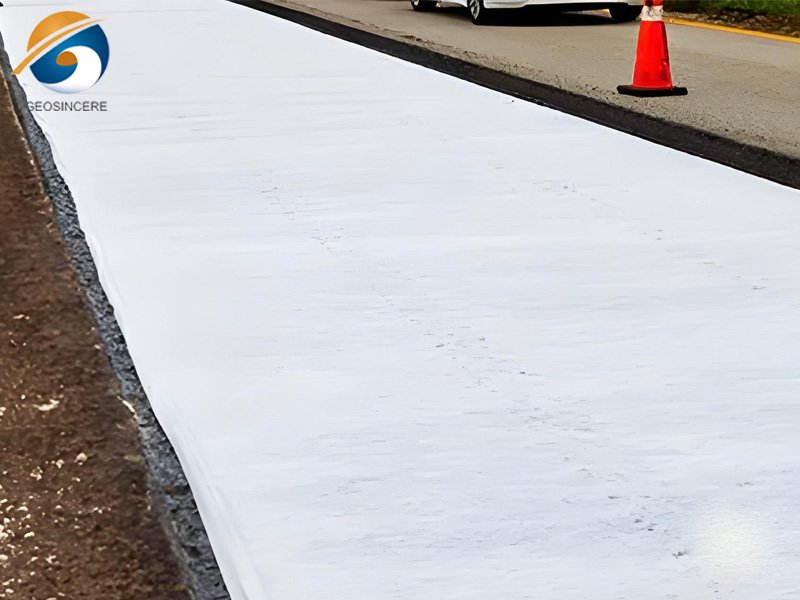
- Roadway and Pavement Stabilization: As base separators, preventing aggregate-soil mixing; a 2025 highway project in India saved 15% on maintenance using 300 GSM wovens.
- Erosion Control and Coastal Protection: Filtration layers in revetments, reducing scour by 70% (US Army Corps data).
- Drainage Systems: French drains and landfill liners, with non-wovens achieving 95% void retention for leachate management.
- Environmental Remediation: Caps for contaminated sites, enhancing capping efficiency by 40% over traditional soils.
Benefits include reduced material usage (up to 30% less aggregate), faster installation (2-3x quicker than gravel), and environmental sustainability—recyclable PP variants lower carbon footprints by 25%. Compared to geogrids, geotextiles offer superior filtration at 20-40% lower cost for separation tasks, though geogrids excel in high-tensile reinforcement.
In essence, geotextile sheets deliver engineered precision, transforming challenging sites into stable, efficient infrastructures.
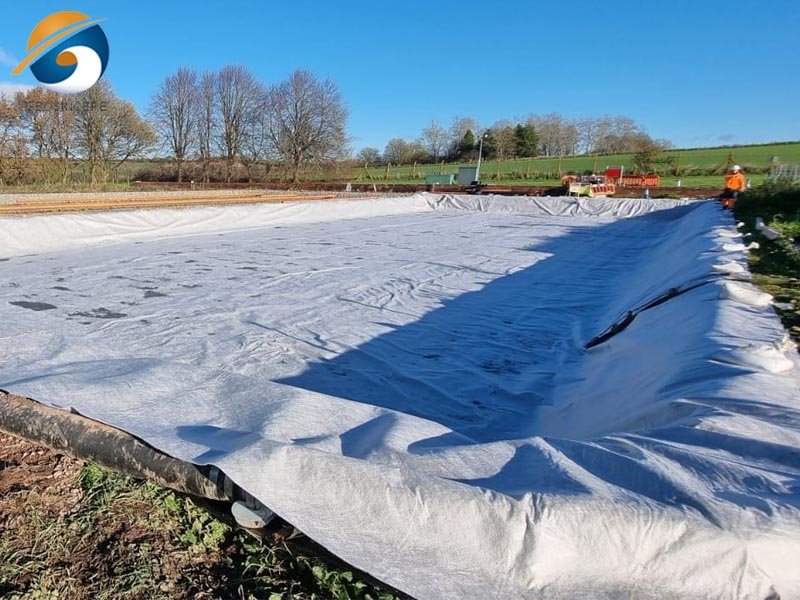

2. How Much Is Geotextile Sheet Price?
Geotextile sheet pricing defies uniformity, with 2025 averages spanning $0.20-$3.50 per square meter ($0.019-$0.32 per square foot), per global benchmarks. This variance stems from raw PP resin costs ($1,200/MT in Q1 2025, up 7% YoY), manufacturing scale, and regional logistics. Installed costs, encompassing labor and accessories, add $0.50-$1.50/m², elevating totals to $1.00-$5.00/m² for comprehensive systems. Below, we dissect these elements with quantitative insights.
2.1 Geotextile Sheet Price – Material Composition and Type
Material selection drives 40-60% of costs, as fiber quality dictates longevity and performance.
- Polypropylene (PP): Dominant (70% market share), UV-stabilized for 50+ year exposure. Base cost: $0.10-$0.30/m² for 100 GSM. A 200 g/m² non-woven uses $0.02-$0.03/ft² in resin alone.
- Polyester (PET): Superior in wet conditions (hydrolysis resistance >90%), for marine applications. Premium: $0.25-$0.50/m², 30-50% higher due to higher melt viscosity.
- Polyethylene (PE): Cost-effective for temporary uses, $0.08-$0.20/m², but limited to 20-30 year lifespan.
Woven types add 20-30% for yarn weaving, while non-wovens benefit from faster thermal bonding, trimming 10-15% off production. In 2025, recycled content variants reduce prices by 5-10% amid sustainability mandates.
2.2 Geotextile Sheet Price – Weight and GSM Specifications
GSM directly correlates with robustness, accounting for 25-35% of variance.
- Lightweight (80-200 GSM): Thickness 0.5-1.2 mm, tensile 10-50 kN/m. Price: $0.15-$0.40/m². Suited for filtration in landscaping, e.g., a 100 GSM PP sheet at $0.20/m² cut weed growth 90% in trials.
- Medium Weight (200-400 GSM): 1.5-2.5 mm thick, puncture >800 N. Cost: $0.40-$0.80/m². Standard for road bases, balancing strength and permeability (300 L/m²/s).
- Heavyweight (400-1,000 GSM): 3-4.7 mm, grab strength 250-350 lbs. Premium: $0.80-$2.50/m² for reinforcement, e.g., 600 GSM in retaining walls enduring 200 kPa loads.
Each 100 GSM increment raises costs by $0.15-$0.25/m², per ASTM D5261 testing, with heavyweights justifying premiums via 40% reduced settlement in soft soils.
2.3 Geotextile Sheet Price – Thickness and Structural Parameters
Though secondary to GSM, thickness impacts compressibility and protection.
- Thin (0.5-1.5 mm): High flow (400+ L/m²/s), $0.10-$0.30/m². Ideal for drainage wraps.
- Standard (1.5-3 mm): Balanced for separation, $0.30-$0.70/m², with 50-70% elongation.
- Thick (3-4.7 mm): Enhanced cushioning (>1,000 N puncture), $0.70-$1.50/m² for geomembrane overlays.
Data from EN ISO 9864 shows 0.5 mm increments add 10-15% to price, yet boost durability 25% under traffic loads.
2.4 Geotextile Sheet Price – Project Size and Scale
Volume procurement unlocks economies, reducing unit costs 15-40%.
- Small Projects (<1,000 m²): Logistics dominate; $0.50-$1.00/m² for custom cuts.
- Medium (1,000-10,000 m²): Discounts apply; $0.30-$0.60/m², common for site developments.
- Large (>10,000 m²): Bulk rates $0.20-$0.40/m², with free delivery on 50+ rolls. Mega-projects in Asia-Pacific leverage local production, saving 20% on freight.
A 2025 report highlights 10,000 m² roadway jobs netting 25% savings via tiered pricing.
2.5 Geotextile Sheet Price – Installation Method and Labor
Deployment costs 20-40% of totals, varying by technique.
- Surface Placement: Unrolling and anchoring; $0.20-$0.50/m² labor (1-2 days/1,000 m²).
- Buried Systems: Overlap seaming (150-300 mm); adds $0.30-$0.70/m² for staples or adhesives.
- Integrated with Geosynthetics: Welding to geomembranes; $0.50-$1.00/m², per ASTM D4885 testing.
Geotextiles install 3-4x faster than granular fills, slashing labor by $2,000-$5,000/hectare. Proper overlap ensures 95% efficacy against migration.
2.6 Geotextile Sheet Price – Quality Control and Certifications
Certified products command 10-20% premiums but avert failures.
- Basic: Meets AASHTO M288; $0.15-$0.40/m².
- Premium (ISO 9001/ASTM): UV resistance >1,500 kJ/m², $0.40-$0.80/m².
Metrics like <5% mass variance and >95% retention post-cycling justify investments, cutting rework 30%.
2.7 Geotextile Sheet Price – Transportation, Logistics, and Lifetime Expenses
Shipping for 100-kg rolls: $0.05-$0.20/m² domestic, 2x international. Lifecycle favors geotextiles: 75-year design life vs. 20-30 for untreated soils, with $0.02-$0.05/m² annual inspections.
For a 5,000 m² project, expect $1,500-$3,000 total, per 2025 indices.
3. How to Choose the Right Geotextile Sheet
Optimal selection merges site analysis with fiscal prudence. Follow this framework:
3.1 Evaluate Project Requirements and Site Conditions
Assess loads (e.g., >100 kPa for roads), hydraulics (<0.5 mm AOS for fine soils), and exposure (UV >500 hours). Wovens suit high shear; non-wovens, high flow.
3.2 Prioritize Specifications and Certifications
Target GSM matching needs (e.g., 200+ for erosion), verified by third-party labs. Certified fabrics reduce risks 40%, per GRI standards.
3.3 Consider Installation Compatibility and Durability
Ensure overlap feasibility and synergy with adjacents like geogrids. Flexible non-wovens adapt to 20% deformations better.
3.4 Analyze Long-Term Value and Sustainability
Lifecycle costing: Geotextiles amortize 15-25% savings over 50 years. Eco-variants with 50% recycled content align with ESG goals.
3.5 Source from Reputable Suppliers
Compare bids from innovators like Shandong Geosino New Material Co., Ltd. (Geosincere Geosynthetics) for custom specs and 15-20% volume discounts.
This approach yields resilient, economical solutions.
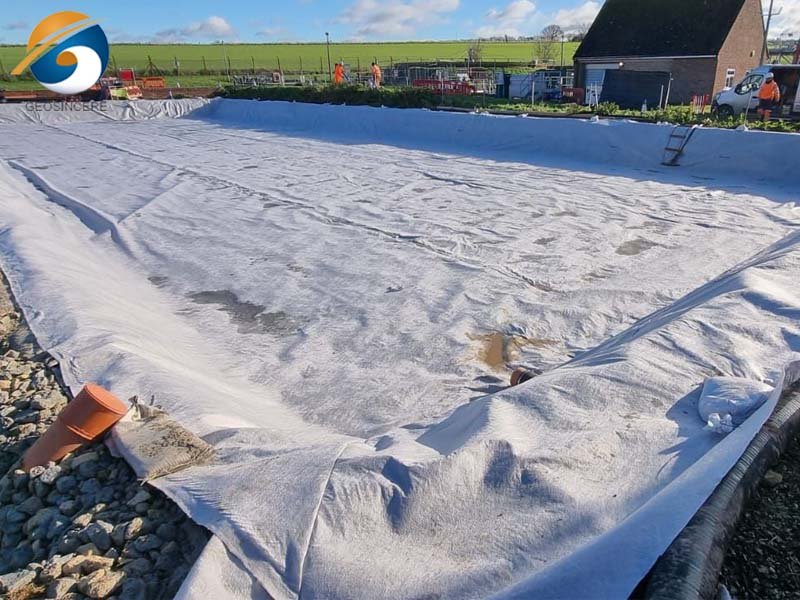
4. Industry Trends Affecting Geotextile Sheet Price
2025 trends are recalibrating the landscape:
- Sustainability Integration: Recycled PET blends drop costs 8-12%, capturing 25% market share amid EU directives.
- Smart Geotextiles: Embedded sensors for real-time monitoring add $0.10-$0.30/m² but cut maintenance 30%.
- Regional Growth: Asia-Pacific’s 12% CAGR drives localized pricing ($0.15-$0.40/m²), vs. North America’s $1.37B market at 4.4% CAGR.
- Raw Material Dynamics: PP volatility (7% Q1 rise) tempers by bio-based alternatives, projecting 4-6% stabilization.
Vigilant monitoring positions buyers for 10-15% savings.
5. Conclusion
Mastering geotextile sheet price—from $0.15/sq ft basics to $0.50+ premiums—demands dissecting specs like GSM (80-1,000) and tensile (10-350 kN/m) against project imperatives. In a market ballooning to $28.90B by 2035, strategic choices unlock 20-30% efficiencies, fortifying projects with enduring stability.
For bespoke quotes, technical support, or tailored geotextiles, partner with Shandong Geosino New Material Co., Ltd. (Geosincere Geosynthetics). Pioneering since 2007, we deliver ISO-certified excellence, competitive rates, and worldwide logistics。 Elevate your next venture—precision starts here.