
Geomembrane liners are indispensable barriers in modern engineering, environmental protection, and industrial projects, designed to contain fluids, gases, and contaminants while preventing seepage into soil and groundwater. As global infrastructure demands intensify—with the geomembrane market valued at USD 2.61 billion in 2026 and projected to reach USD 3.60 billion by 2030 at a 6.61% CAGR (Mordor Intelligence, 2026)—understanding the price of geomembrane liners becomes crucial for project managers, engineers, and procurement specialists. These synthetic sheets, typically made from polymers like high-density polyethylene (HDPE) or linear low-density polyethylene (LLDPE), offer low permeability (≤10⁻¹¹ cm/s) and lifespans of 20–100 years, ensuring 99.9% containment efficiency per Geosynthetic Institute standards (2024).
The price of geomembrane liners varies widely, ranging from $0.28 to $3.00 per square foot ($3.00–$32.29 per square meter) for materials alone, excluding installation, which can add 20–50% to total costs (BPM Geosynthetics, 2026). Factors such as material type, thickness, project scale, and quality influence these figures, with virgin resin options costing 20–30% more than recycled but offering superior durability. This guide, informed by 2026 market data from sources like Grand View Research and BPM Geosynthetics, provides a manufacturer’s perspective to help you budget effectively for applications like landfills, mining tailings ponds, aquaculture, and water reservoirs. By leveraging economies of scale and certified suppliers, projects can achieve 15–25% savings without compromising performance.
1. What Are Geomembrane Liners?
Geomembrane liners are impermeable synthetic membranes engineered to act as barriers against the migration of liquids, gases, and solids in containment systems. Composed primarily of polymeric materials, they exhibit exceptional chemical resistance, UV stability, and mechanical strength, making them vital for environmental compliance and resource protection. Unlike traditional clay or concrete liners, geomembranes provide a uniform, low-permeability layer (typically <1×10⁻¹² cm/s) that reduces seepage by up to 98% compared to natural barriers, per EPA guidelines (2024). Their flexibility allows adaptation to irregular surfaces, while weldable seams ensure 99% integrity in field installations.
Common Applications of Geomembrane Liners
Geomembrane liners are deployed across diverse sectors, accounting for over 1,500 annual global projects in waste management and infrastructure (Mordor Intelligence, 2026). Key uses include:
- Waste Management: As bottom liners and caps in landfills, preventing leachate from contaminating aquifers. They represent 35% of geomembrane demand, with HDPE variants dominating due to 50-year durability (Geosynthetic Institute, 2024).
- Water Management: Lining reservoirs, canals, and irrigation ponds to conserve water, used in 25% of applications. For instance, a 2026Philippine aquaculture project employed 0.5 mm HDPE liners to save 30% on water loss versus clay systems (BPM Geosynthetics case study).
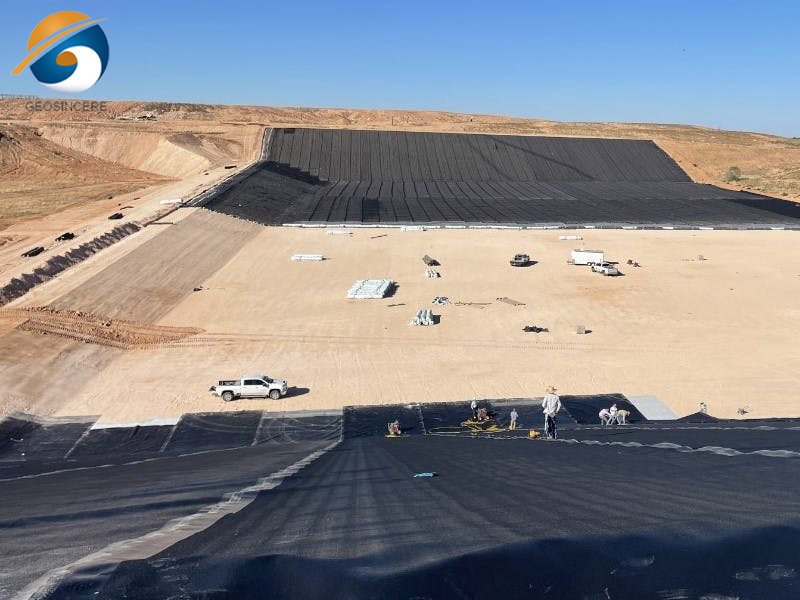
- Mining Operations: Containing tailings and heap leach pads, where textured liners enhance slope stability by 25% (ASTM D5321). In a 2023 Congo mining site, 2.0 mm textured HDPE liners reduced leakage by 99%, preventing $500,000 in remediation (BPM Geomembrane).
- Aquaculture and Ponds: Flexible LLDPE liners for fish farms, supporting 20% higher yields through non-toxic containment (USDA, 2024).
- Industrial Containment: Wastewater lagoons and chemical storage, with conductive layers for leak detection, growing at 5% annually due to regulations.
These applications highlight geomembranes’ role in sustainability, reducing environmental risks while optimizing operational efficiency.
Key Specifications and Parameters
Geomembrane liners must meet rigorous standards like GRI-GM13 (HDPE) or ASTM D7466 to ensure performance. Essential parameters include:
- Thickness: 0.5–3.0 mm (20–120 mil), directly impacting cost and puncture resistance (600–1,200 N per ASTM D4833).
- Tensile Strength: 18–55 kN/m (ASTM D6693), supporting loads up to 300 kPa in high-stress environments like mining.
- Elongation at Break: 200–800% for flexibility, with LLDPE offering superior conformance to uneven substrates.
- Permeability: ≤10⁻¹¹ cm/s, achieving 99.9% containment in leachate collection systems.
- Puncture Resistance: 800–1,200 N, enhanced by geotextile underlays in 60% of installations.
- UV Resistance: 2.5% carbon black additive extends exposed lifespan to 20–30 years (ASTM D4355).
- Chemical Resistance: Withstands pH 2–12, ideal for acidic mining effluents (EPA, 2024).
These specs, verified through oxidative induction time (OIT) tests (>100 minutes), ensure liners withstand thermal cycling (-40°C to 80°C) and oxidative degradation, per Geosynthetic Institute (2024). For a 10,000 m² landfill, selecting 1.5 mm HDPE with these parameters costs $0.50–$2.55 per square foot but yields a 40–100-year service life, far outpacing recycled alternatives (10–20 years).


2. What Is Price of Geomembrane Liner?
The price of geomembrane liners in 2026 averages $0.50–$2.50 per square foot ($5.38–$26.91 per square meter) for materials, with total installed costs reaching $0.75–$5.00 per square foot when including labor and site prep (BPM Geosynthetics, 2026). This range reflects a 5–7% increase from 2024 due to resin price volatility tied to crude oil fluctuations (Grand View Research, 2026). HDPE dominates at 55% market share for its balance of affordability and durability, while premium options like EPDM suit specialized needs. Installation adds 30–60% to budgets, emphasizing the need for certified crews to avoid 15% failure rates from improper seaming.
Excluding accessories like geotextiles ($0.30–$1.00 per square foot), core pricing is driven by upstream factors: resin costs (60–70% of total), manufacturing (15–20%), and logistics (10–15%). Bulk orders over 50,000 m² yield 15–25% discounts, per Alibaba wholesale data (2026). For a 20,000 m² mining pond, expect $40,000–$100,000 in materials alone, with ROI through 20–30% reduced maintenance over 50 years.
2.1 Price of Geomembrane Liner – Material Type
Material selection accounts for 50% of pricing variance, balancing upfront costs with long-term performance. HDPE offers the best value for high-volume projects, while LLDPE excels in flexibility-demanding scenarios.
2.1.1 High-Density Polyethylene (HDPE)
HDPE, comprising 97.5% polyethylene resin and 2.5% additives (carbon black, antioxidants), leads with a 31.7% revenue share (Grand View Research, 2026). Priced at $0.50–$3.50 per square meter ($0.05–$0.32 per square foot), it provides 30 kN/m tensile strength and 99.9% impermeability.
- Properties: Density 0.94–0.96 g/cm³; UV resistance up to 50 years exposed; chemical resistance to pH 1–14.
- Applications: Landfills (35% usage), mining tailings (25%), reservoirs.
- Advantages: 20–30% cheaper than EPDM; 40–100-year lifespan buried; GRI-GM13 compliant.
- Cost Example: 1.5 mm smooth HDPE at $1.50–$2.50 per square meter for a 10,000 m² landfill totals $15,000–$25,000, saving 20% vs. PVC (BPM Geosynthetics, 2026).
In a 2024 Nigeria landfill case, 1.5 mm HDPE at $2.50 per square meter for 10,000 m² cost $25,000, achieving 50-year durability and 20% savings over PVC ($30,000).
2.1.2 Linear Low-Density Polyethylene (LLDPE)
LLDPE, with 800–1,000% elongation, suits irregular terrains at $0.60–$2.50 per square meter ($0.06–$0.23 per square foot), 20–30% less than HDPE for moderate-stress uses.
- Properties: Density 0.92–0.94 g/cm³; puncture resistance 700 N; flexibility for 3H:1V slopes.
- Applications: Ponds (25% market), aquaculture, secondary landfill liners.
- Advantages: 200–300% better conformance than HDPE; fish-safe (NSF-61 certified); 15–30-year lifespan.
- Cost Example: 40 mil (1.0 mm) LLDPE at $0.50–$1.50 per square foot for a 5,000 m² stormwater pond totals $12,500–$37,500, per BPM (2026).
A 2026 Canadian golf course pond used 40 mil LLDPE at $0.70 per square foot, enhancing retention while cutting clay costs by 30%.
2.1.3 Polyvinyl Chloride (PVC)
PVC, a flexible vinyl at $0.60–$2.00 per square meter ($0.06–$0.19 per square foot), is budget-friendly for short-term projects but less durable (15–25 years).
- Properties: Elongation 200–400%; easy seaming with adhesives; moderate UV resistance.
- Applications: Temporary caps, small ponds, decorative features.
- Advantages: 15–25% cheaper installation; conforms to complex shapes.
- Cost Example: 30 mil PVC at $0.28–$1.50 per square foot for irrigation totals low upfront but higher lifecycle due to replacements.
In a 2024 U.S. small pond, 30 mil PVC met EPA standards at minimal cost, per btlliners.com.
2.1.4 Ethylene Propylene Diene Monomer (EPDM)
EPDM, rubber-based at $0.75–$2.50 per square meter ($0.07–$0.23 per square foot), excels in UV-exposed areas with 20–30-year lifespans.
- Properties: 600–700% elongation; fish-safe; ozone resistance.
- Applications: Exposed ponds, roofing, caps.
- Advantages: Self-healing punctures; 300% more flexible than HDPE.
- Cost Example: For small ponds, $1.00–$2.50 per square foot, per HomeGuide (2026).
A 2024 UAE rainwater pond used EPDM for 25% better evaporation control.
Virgin materials like HDPE ensure 95% reliability, per Civil Engineering Journal (2026), justifying premiums for critical uses.
2.2 Geomembrane Liner Cost – Thickness
Thickness, measured in mm or mil (1 mil = 0.0254 mm), drives 20% of costs, enhancing puncture resistance and longevity.
- 5 mm (20 mil): $0.28–$1.00 per square foot; low-stress ponds, aquaculture.
- 0 mm (40 mil): $0.50–$1.50 per square foot; irrigation, secondary liners.
- 5 mm (60 mil): $1.00–$2.00 per square foot; landfills, standard mining.
- 0–3.0 mm (80–120 mil): $1.50–$3.00 per square foot; high-risk mining, hazardous waste.
Thicker liners reduce failures by 30% (ASTM D4833), but over-specifying adds 20–30% costs. For a 20,000 m² tailings pond, 2.0 mm HDPE at $3.50 per square meter totals $70,000, per Congo case (2023).
2.3 Price of Geomembrane Liner – Project Size and Scale
Scale influences pricing via economies: small projects (<1,000 m²) cost $1.00–$3.00 per square foot due to setup fees; large (>50,000 m²) drop to $0.50–$2.00 with 10–20% discounts.
- Small-Scale: Custom cuts add 15–25%; e.g., 500 m² pond at $2.50 per square foot.
- Medium-Scale: 5,000–20,000 m²; balanced logistics, 5–10% savings.
- Large-Scale: Bulk resin buys cut 15–25%; e.g., 100,000 m² landfill at $1.20 per square foot.
A 2026 Philippines 5,000 m² fish pond saved 30% ($5,000 total) via scale, per Made-in-China.
2.4 Price of Geomembrane Liner – Installation Method and Labor
Installation comprises 20–50% of budgets ($0.50–$3.00 per square foot), varying by technique.
Installation Techniques:
- Heat Welding: $0.30–$0.75 per square foot for seams; 99% integrity (ASTM D6392).
- Adhesives/Mechanical: $0.10–$0.30 per square foot; suits PVC/EPDM.
Labor and Site Factors:
- Rates: $10–$50/hour; skilled crews cut failures by 20%.
- Site Prep: $0.20–$0.50 per square foot for grading.
- Climate: Cold weather adds 10–15% for heated tools.
A 10,000 m² canal project: $7,500 materials + $5,000 install = $12,500 total (BPM, 2026).
2.5 Price of Geomembrane Liner – Raw Material Quality
Quality, via virgin vs. recycled resin, affects 20–30% of costs and lifespan.
Virgin vs. Recycled:
- Virgin Resin: $0.50–$2.55 per square foot; 40–100 years; 20–30% less maintenance.
- Recycled: $0.28–$1.00; 5–10 years; risks defects (15% higher failure).
Additives (UV stabilizers) add 5–10% but extend life by 50%. For critical landfills, virgin HDPE saves $10,000+ in repairs.
2.6 Price of Geomembrane Liner – Transportation and Logistics
Logistics add $0.10–$0.30 per square foot, varying by distance.
- Domestic: 5–10% of costs; Asia lowest ($0.28–$2.00 per square foot).
- International: Tariffs raise 10%; e.g., China-to-US adds 8% (LinkedIn, 2024).
- Packaging: Rolls (5–8 m wide) minimize waste.
BPM’s proximity to resin sources cuts 10–15% for Asian projects.
2.7 Price of Geomembrane Liner – Maintenance and Lifetime Costs
Upfront investments yield savings: inspections $500–$2,000/year; failures $10,000+.
- HDPE: 40–100 years; minimal upkeep.
- Recycled: Doubles costs over 20 years.
Thicker liners save 20–30% long-term; e.g., 1.5 mm HDPE in landfills amortizes to $0.20 per square foot annually.
3. How to Choose the Right Geomembrane Liner
Selecting a geomembrane liner requires aligning specs with project needs for 95% success (Geosynthetic Institute, 2024). Prioritize certified materials to avoid $100,000–$500,000 in failures.
3.1 Assess Project Requirements
Match to applications:
- Aquaculture: 0.5–0.75 mm LLDPE/HDPE ($0.50–$1.50 per square foot); NSF-61 for safety.
- Landfills: 1.5–2.0 mm HDPE ($1.00–$2.55); textured for stability.
- Mining: 2.0–3.0 mm ($2.00–$3.50); chemical-resistant.
3.2 Prioritize Quality
Opt for virgin resin and GRI-GM13 compliance; reduces defects by 15%. Suppliers like Shandong Geosino New Material Co., Ltd (Geosincere Geosynthetics) offer ISO 9001-certified products.
3.3 Evaluate Installation Needs
Skilled welding cuts failures by 20%; factor $0.20–$0.50 per square foot for prep. Use geotextiles for rocky sites.
3.4 Consider Long-Term Costs
Thicker liners save 20–30% over 50 years; lifecycle analysis shows HDPE ROI in 5–10 years.
3.5 Compare Suppliers
Request quotes from multiple, including Geosincere for custom LLDPE. Bulk from Asia saves 10–20%.
4. Industry Trends Affecting Geomembrane Liner Costs
- Sustainability Push: Recycled resins grow 10% annually, cutting costs 20% but requiring hybrid designs for durability (Grand View Research, 2026).
- Resin Volatility: Oil prices up 10% in 2024 raise HDPE by 5–7%; forecasts stabilize at 3% growth.
- Tech Innovations: Sensor-embedded liners add 20% but reduce maintenance 10%; automated welding saves 15% labor.
- Regulatory Shifts: EPA mandates boost certified demand, adding 10% but ensuring compliance.
- Market Expansion: Asia-Pacific leads at 34.5% share, driving 6.5% global CAGR to $4.7 billion by 2032 (DataIntelo, 2026).

5. Conclusion
The price of geomembrane liners, ranging from $0.28–$3.00 per square foot, hinges on informed choices in material, thickness, and scale, delivering unmatched value through 99.9% containment and decades-long performance. As the market evolves toward sustainability and innovation, partnering with reliable manufacturers ensures cost efficiency and environmental stewardship. For tailored quotes, custom specifications, or expert consultation on your landfill, pond, or mining project, contact Shandong Geosino New Material Co., Ltd (Geosincere Geosynthetics) today. Optimize your budget and safeguard tomorrow’s resources with Geosincere’s proven solutions.


